
NDIS Core Funding is one of the most flexible parts of your plan. And, when you understand how it works, it becomes a powerful tool for building independence, staying connected, and making meaningful progress toward your goals.
Whether you need help at home, support to get out into your community, or assistance with everyday essentials, your Core budget is designed to adapt as your needs change and support you in the way that works best for you.
In this guide, we’ll break down what Core Funding actually is, what you can use it for, and how it can help you move closer to the life you want.
What Is NDIS Core Funding?
Core Funding (officially called Core Supports) covers the everyday assistance you need to live your life safely, comfortably, and independently.
It’s designed to be flexible, practical and responsive to help you with daily tasks, participation, and essential supports that maintain your quality of life.
Your Core budget is divided into four categories:
1. Assistance with Daily Life
Support with everyday tasks in your home such as:
- Personal care
- Meal prep
- Cleaning or household tasks
- Support worker drop-in visits
- Support inside SIL environments
- Overnight or active supports when required
2. Consumables
Low-cost everyday items you may need because of your disability, for example:
- Continence products
- Low-cost assistive technology
- Sensory items
- Nutrition supplements (if NDIS-approved)
- Minor safety equipment
3. Assistance with Social & Community Participation
Supports that help you stay connected, participate, and build confidence, including:
- Attending appointments
- Social outings
- Community activities and programs
- Skill-building in the community
4. Transport
Funding that helps you travel to the places that matter such as medical appointments, work, study, or community social activities.
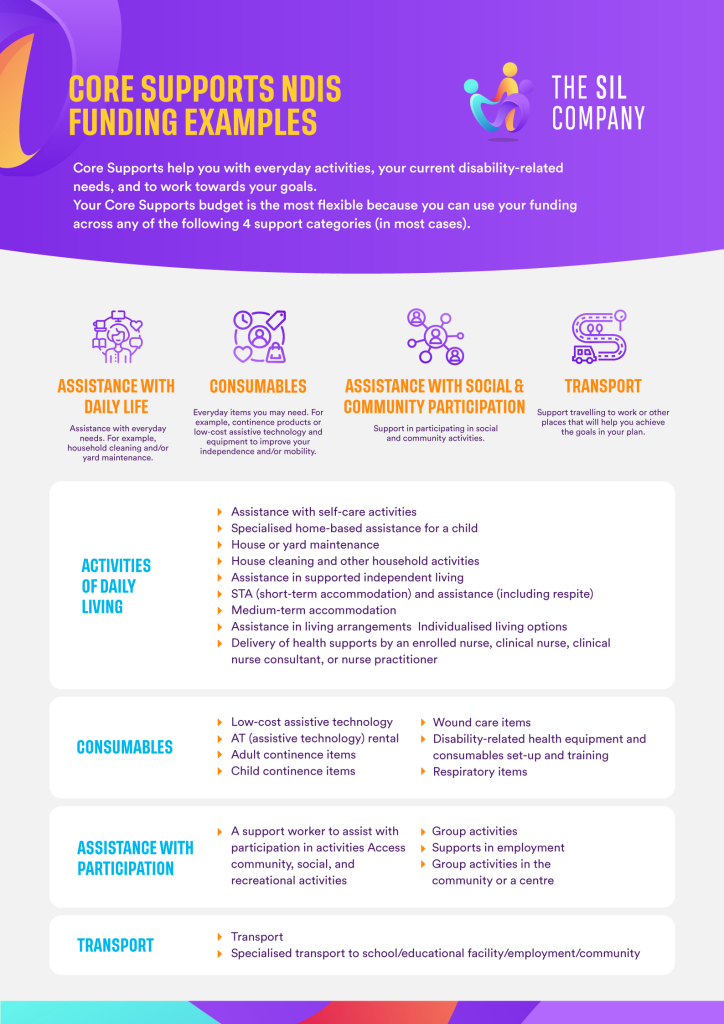
Together, these categories give you the flexibility to structure your supports around what matters most: your safety, independence and participation in everyday life.
What Can I Use My NDIS Core Funding For?
A common question we get asked is: “What can I use my NDIS Core Funding for?”
The short answer: quite a lot. Core Funding is intentionally flexible so you can tailor it to your needs, as long as it’s in line with your goals.
Examples include:
- Daily living support from a support worker
- Help with personal care routines
- Social and community access
- Assistance to build skills like cooking or cleaning
- Transport to appointments or activities
- Supports related to living in a SIL environment
- Consumables such as continence products, low-cost tech, or safety equipment
- Supports inside SIL or ILO households
- Support worker assistance during transitional accommodation
As long as the support is reasonable, necessary and linked to your disability and goals, it can often be funded under Core.
Many participants rely on their Support Coordinator or Local Area Coordinator (LAC) to help interpret funding rules. If you’re unsure what your Core budget can cover, speak with your coordinator, or we’re happy to discuss it directly with them so you feel confident and supported.
How Core Funding Helps You Reach Your Goals
Your goals might be long-term and big-picture, such as becoming more independent. Or, they can be smaller day-to-day steps, like learning to manage a new routine. For many participants, achieving goals doesn’t happen in a single moment, it happens in hundreds of small, consistent steps. Core Funding helps make those steps possible every day.
Core funding can help you reach your goals by:
Building independence
Regular drop-in supports, help with daily tasks, or travel training can slowly shift tasks from “I need help” to “I can do this on my own”.
Staying connected
Supports for social and community participation make it easier to build friendships, access programs and stay active in your community.
Developing everyday skills
Working alongside a support worker gives you the chance to learn or strengthen skills such as grocery shopping, cooking, budgeting or organising your home.
Maintaining stability and routine
Core supports are often the foundation of your week, making sure you have the consistency you need to feel confident and supported.
Using Core Funding for MTA, Respite or Drop-In Supports
Core Funding can also help during times when your support needs shift.
Respite / Short Term Accommodation (STA)
STA can be funded under Core if it aligns with your goals. It can support you by:
- Providing a short-term change in routine
- Offering rest for informal supports
- Helping stabilise behaviour or routines
- Allowing you to trial time away from home with the right supports
You can choose the provider, location and level of support that feels comfortable for you.
Medium Term Accommodation (MTA)
While the NDIS generally pays the accommodation component separately, your Core budget can fund the support worker assistance you need during your MTA stay.
This may include:
- Personal care
- Help with routines during the transition
- Meal preparation
- Community access from the temporary location
- It’s especially useful while waiting for SDA, SIL or other long-term housing solutions.
Drop-In Supports
Drop-in supports (also known as assistance with daily living) are one of the most common ways people use Core Funding. These supports are short, flexible visits that can assist with:
- Daily tasks
- Meal prep
- Medication prompts
- Learning or strengthening skills
- Emotional reassurance
- Community access
Drop-ins are ideal for participants who don’t need 24/7 support, but benefit from regular check-ins throughout the week.
Here at The SIL Company we can help you get the support you need, whether its drop-in supports or MTA assistance.
How Core Funding Can Help You Get a Home & Living Package
Many participants begin their NDIS journey with Core Funding only. They may not yet have Supported Independent Living (SIL), Independent Living Options (ILO), Medium Term Accommodation (MTA), or any other Home & Living supports included in their plan.
What most people don’t realise is that your Core Funding can actually play an important role in helping you access a Home & Living package in the future. Here’s how:
1. Core supports help demonstrate your day-to-day support needs
Support workers funded through Core can help stabilise routines, record the type of assistance you regularly require, and highlight areas where you need ongoing support.
This becomes valuable real-world evidence when applying for SIL or ILO.
For example:
- If you need daily prompting, personal care, or assistance with meals
- If you rely on drop-in visits for safety or independence
- If you require community access support each week
- All of this helps demonstrate the level of support you need to live safely in your chosen environment.
2. Core supports can be used while waiting for a Home & Living decision
The approval process for Home & Living supports can take time.
During this period, participants often use Core Funding for short-term solutions, such as:
- Drop-in supports
- Extra daily living assistance
- MTA stays while transitioning to SDA or SIL
- Skill-building to prepare for more independent living
This helps maintain stability and ensures that support doesn’t pause while waiting for a decision.
3. Your Core Funding can help strengthen your supporting evidence
The NDIS relies heavily on evidence to approve a Home & Living package.
Using your Core budget strategically can help collect that evidence, for example:
- Support workers can document what assistance you need and how often
- Allied health therapists funded through Capacity Building (if applicable) can work alongside Core supports
- Your Support Coordinator or LAC can help identify patterns, risks and support gaps
- Providers like us can offer written observations about your daily functioning
This combination of lived evidence and clinical reporting significantly improves your likelihood of approval.
4. Core supports help clarify whether SIL, ILO or another model is the best fit
Many participants aren’t sure which Home & Living option they need.
By using Core Funding for day-to-day supports, you can trial routines, understand your independence levels, and identify what living arrangement will help you thrive.
For example:
- Someone relying heavily on drop-ins may benefit from SIL
- Someone stable with minimal support may be better suited to ILO
- Someone with high physical needs may require SDA
Core Funding helps uncover what works for you (and what doesn’t).
5. We work with your Support Coordinator to build a strong Home & Living request
Most participants don’t navigate this process alone.
Support Coordinators play a major role in preparing Home & Living applications, and we work closely with them to:
- Review your current Core-funded supports
- Identify support gaps
- Highlight safety or functional risks at home
- Shape your goals to align with NDIS Home & Living criteria
- Prepare evidence about the supports you receive and the outcomes you’re working towards
This collaborative approach helps ensure your application clearly demonstrates your needs.
Is Core Funding Flexible?
Yes, Core Funding is one of the most flexible parts of your NDIS plan.
You can usually move your budget between the first three categories (Daily Life, Consumables, Community Participation), depending on your priorities. Transport is the only category that cannot be moved into or out of.
This flexibility means you can adjust your supports if:
- Your needs change
- Your routines shift
- You want to try a new activity
- You need more support in one area for a period of time
NDIS Core Funding flexibility is designed so your plan can support you in real, practical ways rather than locking you into rigid boxes.
How to Avoid Your Core Funding Running Out
Because Core supports are flexible and widely used, it’s important to keep an eye on your spending so your budget lasts the full plan period.
Here are practical ways to make it stretch:
- Know your weekly budget, not just the total amount.
- Use rostered hours instead of ad-hoc bookings where possible.
- Review your spending monthly, especially if you use multiple providers.
- Talk to your provider if you notice support needs increasing (even small changes add up quickly).
- Use a Support Coordinator or Plan Manager to help with budget tracking.
- Flag changes early. If your needs increase, start gathering evidence rather than waiting until funds are exhausted.
A well-managed Core budget gives you flexibility and peace of mind. And helps ensure your supports remain consistent throughout your entire plan period.
Core Funding vs Capacity Building: What’s the Difference?
The two budgets work together, but they’re not the same.
Core Funding supports your daily life and helps you manage essential tasks.
Capacity Building supports help you learn new skills, build long-term independence, and work on specific goals (like therapy, employment, or health).
Think of it this way – Core helps you live your life today, while Capacity Building helps shape your life tomorrow.
How We Support You With Your Core Funding
As a professional NDIS provider making a difference for people living with complex needs or disability, we’re here to make your supports simple and stress-free.
We offer:
- Supported Independent Living (SIL)
- Drop-in daily activity & living supports
- Community activities and programs
- Transport assistance
- 24/7 support options
- Help understanding and using your NDIS plan
Our role is to understand your goals, listen to what matters to you, and tailor supports that genuinely help you move forward. Whether that’s gaining independence at home, getting out into the community, or building a reliable weekly routine.
Common Questions About Core Funding
Below are some of the most common questions we hear from participants and families about Core Funding.
What is Core Funding NDIS?
It’s the funding for everyday supports that help you manage daily life, build independence, and stay connected.
What can I use my NDIS Core Funding for?
Daily living support, consumables, transport, community participation, low-cost assistive tech, and other reasonable and necessary supports.
Can I move money between Core categories?
Yes (except for transport), most Core budgets are fully flexible.
Does Core Funding roll over?
No. Your plan funding doesn’t roll over at the end of your plan period.
Can I choose my own support workers?
Yes. You have full choice and control. As part of our transitioning process, we work to match you with suitable support workers that make you feel comfortable and have the right training to support you.
Core Funding is one of the most flexible and valuable parts of your NDIS plan. When you understand how it works (and how to manage it well) it becomes a practical foundation for building independence, maintaining routines and reaching your personal goals.
Everyone’s needs look different, and your supports should reflect that. Whether you need daily living assistance, community access, transitional support, or short, reliable drop-in visits throughout the week, your Core budget can often be shaped around the life you want to live.
If you’d like personalised support to make the most of your Core Funding, or you’re exploring Supported Independent Living or Drop-in Supports, our team is here and ready to help. We’re friendly, responsive and committed to helping you live the life that feels right for you.